
The Money Flow Index
Now that we've taken a look at the Relative Strength Index (RSI), let's take a look at a more stringent momentum indicator. The Money Flow Index measures the strength of money flowing into and out of a stock. The difference between the RSI and Money Flow is that RSI only looks at prices whereas the Money Flow Index also takes volume into account.
Calculating Money Flow is a bit more difficult than the RSI:
First we need the average price for the day:
|
Average Price = |
Day High + Day Low + Close |
|
3 |
Next we need the Money Flow:
Now, to calculate the money flow ratio you need to separate the money flows for a period into positive and negative. If the price was up in a particular day this is considered to be "Positive Money Flow". If the price closed down it is considered to be "Negative Money Flow".
|
Money Flow Ratio = |
Positive Money Flow |
|
Negative Money Flow |
The Money Flow Ratio is then used to calculate the Money Flow Index:
|
Money Flow Index =
100 –
|
100
|
|
( 1 + Money Flow Ratio )
|
The Money Flow ranges from 0 to 100. Just like the RSI, a stock is considered overbought in the 70-80 range and oversold in the 20-30 range.
The shorter number of days you use, the more volatile the Money Flow will be. For the example below we will use a 14 day average.
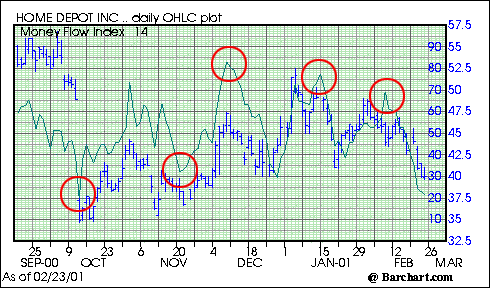 This chart was supplied by Barchart.com
The chart above is for Home Depot (HD), the Money Flow Index is identified by the green line. Notice that each time the Money Flow dropped below 30, the stock began to rally. Furthermore, each time the money flow rose above 70, the stock started to sell off.
Like any indicator, this is not correct 100% of the time. In early October when the stock price dropped from around $55 down to $37 the Money Flow didn't detect a thing. Also remember that Money Flow is useful to detect momentum but it can't predict unsystematic risk.