The Income Statement
The income statement is the most popular financial statement in an annual or quarterly report. The income statement is the "sexy" portion of the financial statements because it includes figures such as revenue, net income, and earnings per share (EPS) . In essence, an income statement tells you how much money a company brought in (its revenues), how much it spent (its expenses), and the difference between the two (its profit/loss), over a specified time.
Profit is, after all, the reason companies are in business. While some new companies are not be expected to be profitable for a few years, over the long run, no company can survive without profits.
The income statement is simply designed, and even simpler to read. The statement is looked at from top to bottom. The top line lists the revenue (sales) brought in. Each subsequent line deducts expenses and costs from the revenue figure until you finally get to the bottom line (net income). Each item that has a line above the number means that it is a subtotal or total (the net income usually has a bold or double line below the number).
Below is the typical layout of an income statement:
Income Statement
- Revenue
- the proceeds that come from sales to customers
- Cost of Goods Sold (COGS)
- an expense that reflects the cost of the product or good that generates revenue. For example, if a loaf of bread costs 50 cents to make, then COGS is 50 cents.
- Gross Margin
- also called gross profit, this is revenue minus COGS
- Operating Expenses
- any expense that doesn't fit under COGS such as administration and marketing expenses.
- Net Income Before Interest and Tax
- net income before taking interest and income tax expenses into account.
- Interest Expense
- the payments made on the company's outstanding debt.
- Income Tax Expense
- the amount payable to the federal and state governments.
- Net Income
- the final profit after deducting all expenses from revenue.
- Net Income Per Share
- the net income divided by the number of shares (stock) owned by the public. Otherwise known as EPS.
There isn't one cookie cutter way to present a company's income statement. The exact information presented depends, to some extent, on the type of business the company is in. For example, some companies will break down their operating expenses into various categories, while others do not. Furthermore, some companies list depreciation expense as a separate line item, while others do not.
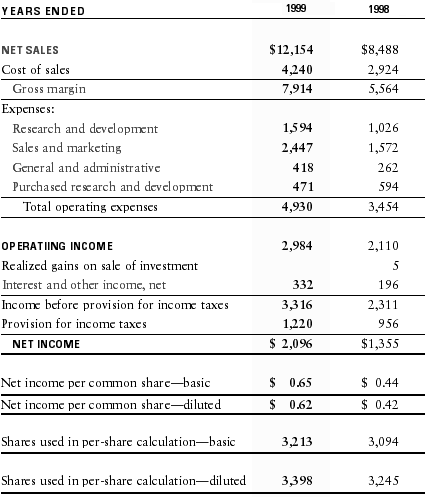
Below is a sample income statement:
Consolidated Income Statement
(in millions, except per-share amounts)